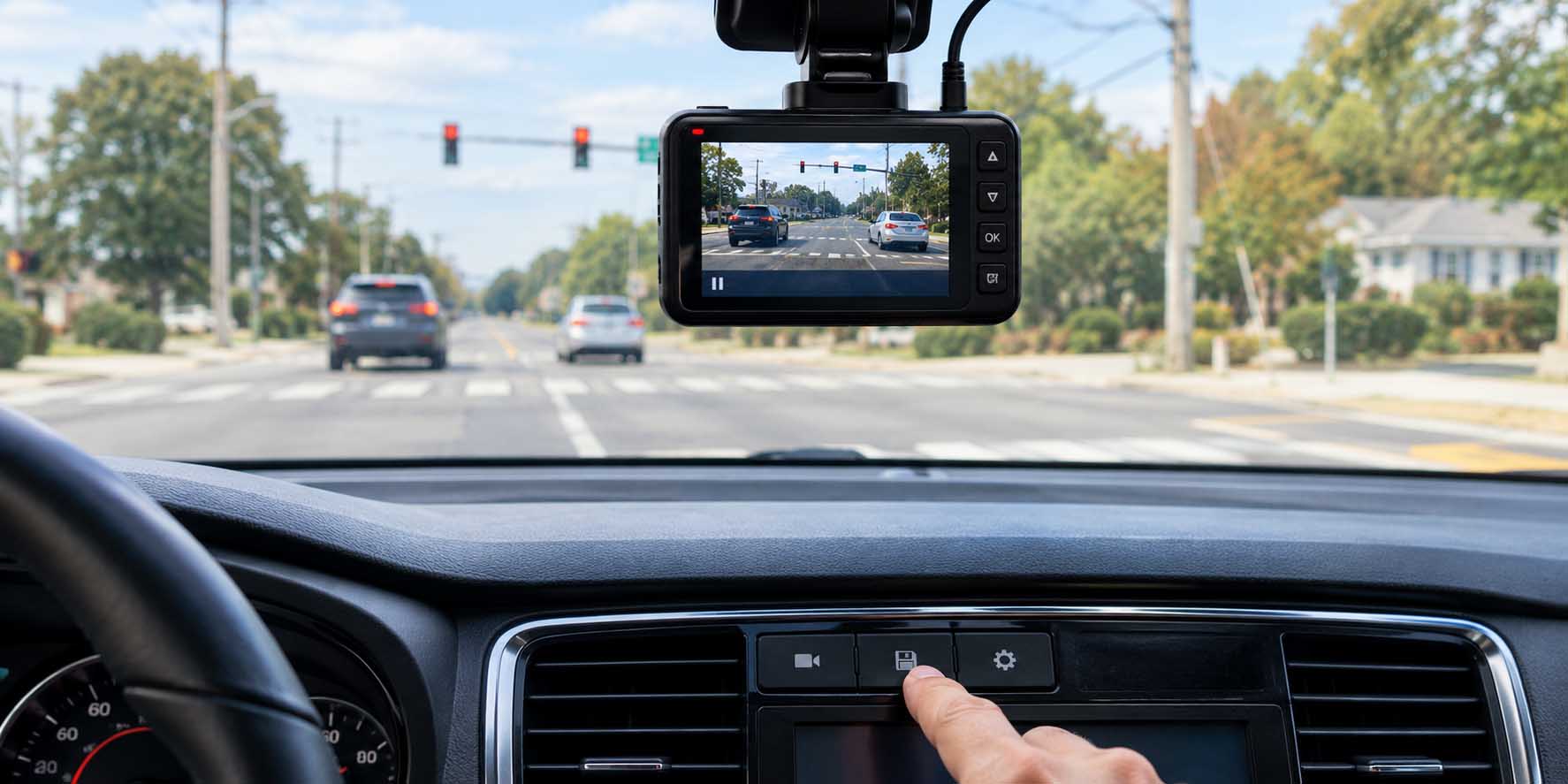
Dashcam evidence after a car accident can help establish how a collision occurred by recording vehicle movements, traffic signals, road conditions, and other details surrounding the incident. Unlike personal recollections, video recordings may preserve events that happened within seconds.
However, dashcam footage does not automatically establish fault or guarantee that an insurance company or court will accept a particular interpretation.
The recording’s quality, completeness, authenticity, and relevance all matter. In addition, surveillance recordings, photographs, and vehicle data may help investigators reconstruct the circumstances of a crash.
Understanding these materials can help drivers preserve potentially valuable evidence after an accident.
What Is Dashcam Evidence After a Car Accident?
Dashcam evidence consists of video or audio recordings that a dashboard-mounted camera or similar vehicle recording device captures.
Some cameras continuously record the road ahead, while others capture both front and rear views.
Depending on the equipment, recordings may also contain timestamps, location information, or vehicle movement data.
For example, footage from a front-facing camera may show whether a traffic signal was red or green when a vehicle entered an intersection.
However, the camera may not capture activity outside its field of view.
Therefore, investigators should consider what the recording shows and what remains unknown.
How Dashcam Evidence After a Car Accident Helps Establish Fault
Dashcam footage may provide information about the actions of drivers immediately before a collision.
For example, a recording might show another vehicle changing lanes without sufficient clearance.
Alternatively, footage may document a driver failing to yield at a stop sign.
These details can help investigators evaluate whether a motorist complied with applicable traffic rules.
However, legal responsibility still depends on the complete circumstances.
A recording may show the impact without revealing earlier events that contributed to the accident.
Consequently, investigators should assess video evidence alongside witness statements, physical evidence, and other available information.
Types of Dashcam and Digital Accident Evidence
Dashcams are only one potential source of electronic accident evidence.
Traffic and Business Surveillance Cameras
Nearby businesses, parking facilities, or other properties may have cameras covering portions of the roadway.
For example, a storefront camera might record vehicles approaching an intersection.
However, recording systems may automatically overwrite older footage.
Therefore, identifying possible sources promptly can help preserve relevant information.
Smartphone Photographs and Videos
Photographs taken after a collision can document vehicle damage, road markings, traffic signs, and surrounding conditions.
In addition, smartphone files may contain metadata showing when someone created a photograph.
However, metadata is not always available or reliable in every circumstance.
Vehicle Electronic Data
Certain vehicles contain electronic systems that may record limited information about vehicle operation around a collision.
Depending on the vehicle and equipment, this information may include speed, braking activity, or other technical details.
However, accessing and interpreting such data may require specialized equipment and expertise.
How to Preserve Dashcam Evidence After a Car Accident
Preserving the original recording matters because some dashboard cameras automatically overwrite older files.
After addressing immediate safety and medical concerns, drivers can take practical steps to protect available footage.
These steps may include:
- Saving the relevant recording before the camera overwrites it
- Preserving the original file whenever possible
- Creating a separate backup copy
- Recording the accident date and approximate time
- Keeping related photographs and recordings organized
- Avoiding unnecessary editing or compression
For example, trimming a recording to show only the moment of impact may remove important surrounding context.
Therefore, retaining the complete original file can help preserve its evidentiary value.
Dashcam and Digital Evidence in Long Island Accident Claims
Car accidents throughout Nassau County and Suffolk County may involve disputed traffic movements, intersection signals, or conflicting driver statements.
For example, a collision near a commercial roadway in Bay Shore may involve questions about which vehicle entered an intersection first.
Available video recordings could help clarify the sequence of events.
Individuals seeking information about accident-related legal issues can explore car accident legal guidance from Siben & Siben, a law firm serving Long Island.
However, the usefulness of digital evidence depends on its reliability and connection to the specific accident.
Can Dashcam Evidence Support a New York Injury Claim?
Potentially, yes.
Dashcam recordings may be relevant in insurance investigations, settlement discussions, and personal injury litigation.
However, parties generally must satisfy applicable evidentiary requirements before a court admits a recording.
For example, a party may need to establish that a recording accurately represents the events it supposedly depicts.
Questions about authenticity, completeness, and possible alterations may affect admissibility or evidentiary weight.
New York’s Civil Practice Law and Rules § 4539 addresses the admissibility of certain photographic reproductions and electronic images of records. However, it does not automatically establish the admissibility of every dashcam video.
In addition, video evidence does not eliminate the need to establish negligence, causation, and damages.
What if Dashcam Evidence Contradicts a Driver’s Statement?
Conflicting evidence may lead investigators to examine the accident more closely.
For example, a driver may report that another vehicle crossed a lane marking immediately before impact.
However, available footage might show a different sequence.
In that situation, the recording may affect the credibility of the competing accounts.
Nevertheless, investigators must consider camera angles, visibility limitations, and recording quality.
A single video may not provide a complete view of every relevant event.
Therefore, conclusions should reflect the available evidence rather than assumptions about what happened outside the recording.
Can Dashcam Footage Prove the Severity of an Injury?
No. Dashcam footage primarily documents visible events surrounding a collision.
Although it may help explain the direction or circumstances of an impact, it generally cannot establish the full extent of an occupant’s medical injuries.
For example, a recording may show a relatively low-speed collision without revealing the physical effects a passenger experienced.
Medical evaluations, diagnostic testing, and treatment records remain important for assessing injuries.
Consequently, accident footage and medical documentation serve different purposes within an injury claim.
Can Missing Dashcam Evidence Affect an Accident Claim?
Missing footage may create practical difficulties when important accident details remain unclear.
However, the absence of a recording does not automatically establish negligence or defeat a claim.
In some circumstances, destroying relevant evidence may raise legal questions about preservation obligations.
These issues depend on factors such as whether litigation was reasonably anticipated and whether a party had a duty to preserve the material.
Therefore, preserving potentially relevant recordings without altering them is generally preferable to relying on later recovery attempts.
Common Mistakes When Handling Accident Video Evidence
Drivers may unintentionally reduce the usefulness of footage by mishandling recordings after a collision.
Saving Only a Short Video Clip
A short clip may omit relevant events before or after the impact.
Therefore, preserving the complete recording can provide additional context.
Overwriting the Original Recording
Some cameras reuse storage space automatically.
As a result, waiting too long to save footage may cause permanent data loss.
Assuming Video Automatically Establishes Fault
Footage may clarify driver movements, but legal responsibility depends on the complete evidence.
For example, a recording may show a collision without revealing a vehicle’s earlier actions or surrounding traffic conditions.
Final Thoughts
Dashcam evidence after a car accident can provide valuable information about vehicle movements, traffic conditions, and the sequence of a collision.
However, investigators must evaluate recordings for authenticity, completeness, and relevance.
Preserving original files, identifying additional recording sources, and considering digital evidence alongside witness accounts and medical documentation can support a more accurate understanding of an accident.
Video footage remains one part of the evidence used to assess responsibility and potential injury claims rather than an automatic determination of legal fault.